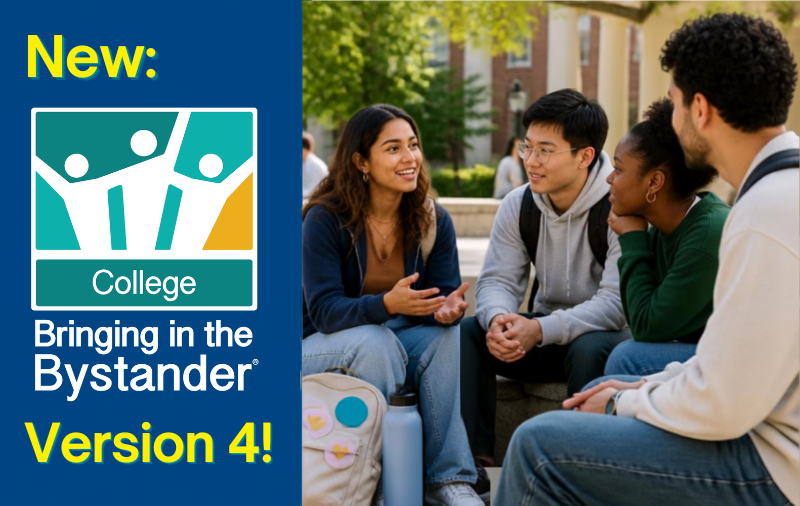
The Next Evolution of Bringing in the Bystander® Is Here: Introducing Version 4
For more than 20 years, Bringing in the Bystander® has helped colleges and universities build safer, more respectful communities by empowering students to recognize situations involving harm and take action as prosocial bystanders.
Now, we are proud to introduce the next evolution of the program.
Introducing Bringing in the Bystander® College Version 4
Built on the program's strong evidence-based foundation, Version 4 reflects what we have learned through years of implementation and, most importantly, what we are hearing from today's students, facilitators, licensed partners, trainers, and researchers.
Campus communities continue to change. Students are navigating increasingly complex social environments, relationships, identities, and experiences. Prevention programming must evolve alongside them.
MORE THAN AN UPDATE
Bringing in the Bystander® has always been grounded in a simple but powerful idea: all community members have a role to play in preventing harm.
The program moves beyond awareness to help students understand their role as active bystanders. Participants learn practical, positive, appropriate, and safe ways to recognize concerning situations and intervene before, during, or after harm occurs.
Version 4 builds on that foundation while strengthening how participants connect bystander intervention skills to the realities of their own lives and communities.
This curriculum moves beyond simply learning skills. It helps students develop and embody the empathy needed to put those skills into practice.
Because knowing what to do is only part of effective bystander intervention. Participants must also be prepared to recognize opportunities, navigate barriers, and make decisions about how they can safely respond in real situations.
WHY DID WE UPDATE VERSION 4?
The student experience has changed.
We listened to students, trainers, license holders, and campus professionals. One message came through clearly: real-world intervention is rarely simple.
Students are often not deciding whether obvious harm is occurring ; they are deciding whether something feels concerning enough to act on.
They are asking:
Version 4 is designed to better support students in navigating these moments of uncertainty by providing a practical framework for recognizing concern, assessing environment and context, and responding authentically. In order to engage more effectively with the CARE framework, students need a curriculum that reflects their:
Version 4 builds on the trusted foundation of Bringing in the Bystander® while responding to what students and campus partners told us they need now.
Our program helps the conversation move beyond “What could a bystander do?” to a more realistic question of “Given the situation, my role, and the options available to me, what can (should) I do?”. By helping students see these realistic and accessible opportunities to act, Version 4 is designed to create more opportunities for bystander intervention across campus and help build a campus where looking out for one another, speaking up, and taking prosocial bystander action becomes the norm.
DESIGNED FOR TODAY'S CAMPUS COMMUNITIES
What Informed This Update?
We started by listening to the people who know Bringing in the Bystander® best: the campuses using it and the students experiencing it. Version 4 was shaped by multiple sources of feedback, research, and implementation experience, including:
- Licensed partners survey results
- Ongoing feedback from Bringing in the Bystander® Train-the-Trainer evaluations
- Feedback from campus administrators, prevention professionals, and students
- Current literature on bystander intervention, sexual and relationship violence, stalking, trauma, and prevention science
- Research conducted by L.B. Klein, including more than 350 survey responses and 15 interviews
Together, these insights highlighted several priorities:
- Relationship dynamics
- Their role and relationships within the group
- Expected peer support
- Confidence/Self-efficacy
- Group norms
- Influence and authority within the situation
These factors (supported by decades of research on prosocial bystander intervention, and social cognitive theory) are more intentionally integrated throughout the curriculum.
Version 4 strengthens representation and encourages participants to consider how individual identities, experiences, and circumstances may influence opportunities, barriers, and responses to bystander intervention.
STRENGTHENING FACILITATION
A great curriculum is only as effective as its implementation.
That is why Version 4 places significant emphasis on strengthening the facilitation experience.
The updated curriculum is designed to support facilitators as they guide meaningful conversations, create engaging learning environments, and help participants practice applying bystander intervention skills.
Through interactive exercises, discussion, small-group work, and opportunities to practice, participants move beyond simply hearing about bystander intervention.
The goal is to help students leave with practical strategies they can use in the moments that matter.
A STRONGER FOUNDATION FOR SUSTAINABLE IMPLEMENTATION
We know that successful prevention work does not happen through a single presentation or training.
Sustainable change requires institutional commitment, skilled facilitators, thoughtful implementation, and the ability to continue building prevention capacity over time.
Version 4 is designed to help institutions strengthen that capacity.
The program provides institutions with tools and resources that support implementation while helping campus teams build a sustainable approach to bystander intervention and prevention.
Whether an institution is introducing Bringing in the Bystander® for the first time or continuing a program that has been part of its prevention strategy for years, Version 4 provides an opportunity to build on what is already working while moving forward with an updated curriculum.
CONTINUING A LEGACY OF RESEARCH AND PREVENTION
Bringing in the Bystander® was developed through decades of groundbreaking research at the University of New Hampshire's Prevention Innovations Research Center.
Over the years, the program has been extensively evaluated, with research demonstrating positive outcomes related to participants' bystander knowledge, attitudes, confidence, and behaviors. Today, Bringing in the Bystander® College is implemented by hundreds of colleges, universities, military installations, and community partner organizations.
Version 4 builds on this foundation.
What Comes Next?
The launch of Bringing in the Bystander® College Version 4 is only the beginning.
In the coming weeks and months, we will be sharing more about:
- What's new in Version 4
- The research and feedback that informed the update
- How campuses can prepare for Version 4
- The role of CARE in supporting successful implementation
- Upcoming Version 4 Train-the-Trainer opportunities
We are incredibly excited to share this next chapter with the Bringing in the Bystander® community.
To the students, facilitators, licensed partners, researchers, and prevention professionals who have contributed their experiences and insights over the years: thank you.
Your feedback has helped shape this next evolution.
The next generation of Bringing in the Bystander® is here.
And together, we can continue building communities where more people recognize their ability, and responsibility, to safely step in when it matters.